
Midwest vs Sunbelt: Where Rental Math Actually Pencils in 2026
The Sunbelt got the headlines and the price run-up. The Midwest kept the yield. An honest comparison of the two theses, line by line.

For an investor buying yield in 2026, the Midwest pencils and most of the Sunbelt doesn't: river-town and heartland markets still clear 1% rent-to-price with honest expenses, while Sunbelt metros ask 2026 prices for 2019 stories — softening rents in oversupplied cities and insurance bills that repriced the region. The Sunbelt remains an appreciation bet. It is no longer a cash-flow one.
Two different products wearing one label
"Rental property" describes both, but the theses are opposites. The Sunbelt thesis: pay a full price where people are moving, accept thin or negative early cash flow, get paid by growth. The Midwest thesis: pay a grounded price where the market is stable, get paid from rent, treat appreciation as a bonus you didn't buy.
Neither is dishonest. What's dishonest is selling the first thesis with the second thesis's vocabulary — "cash flow!" on a property that needs three years of rent growth to break even. The same arithmetic that killed the 1% rule in priced-up metros decides this comparison.
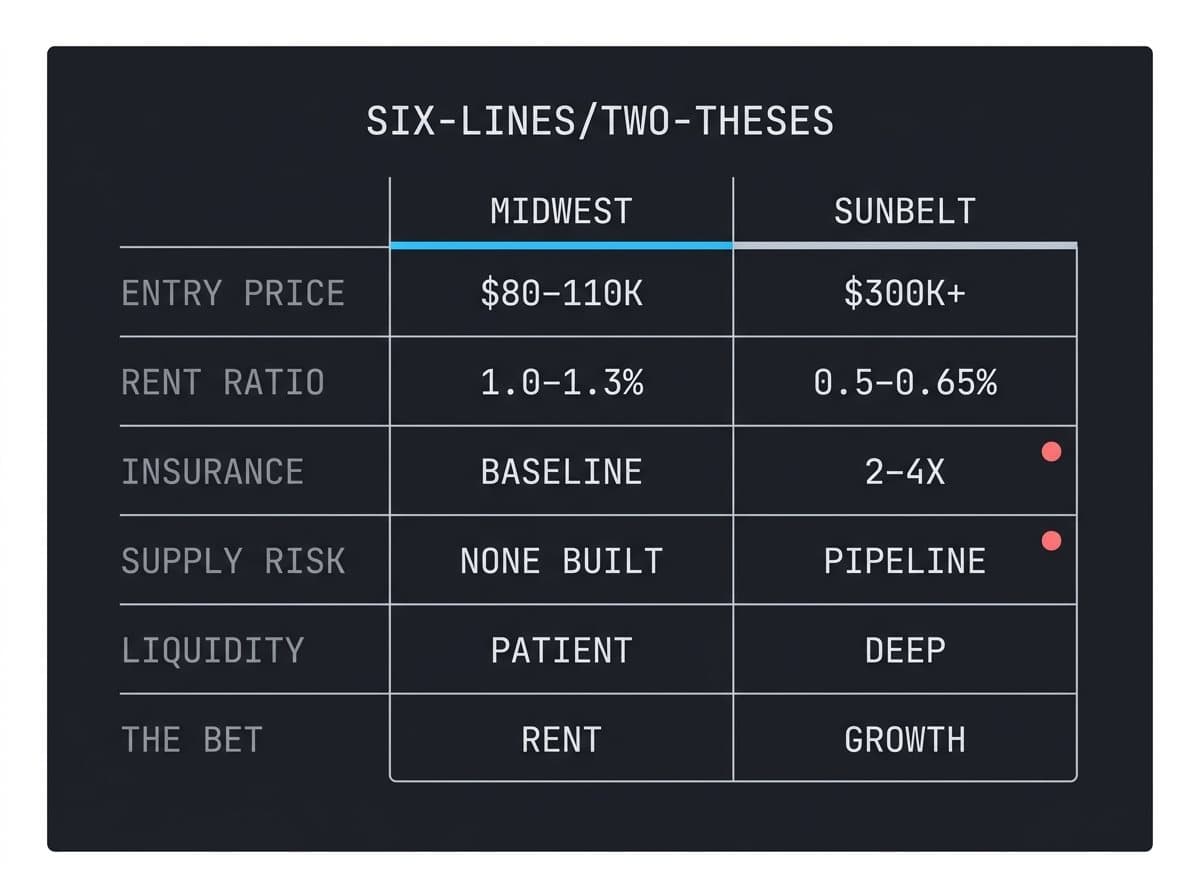
Representative 2026 comparison — single-family rentals
The lines that decide it
Entry price vs income
Midwest small-market prices stayed tied to local wages — $70–100K buys renovated stock that local incomes support renting. Sunbelt entry tripled in a decade; the income that services those rents didn't.
Rent trajectory
Sunbelt rents spiked with migration, then flattened — and in the metros that built hardest, concessions came back. Midwest small-market rents never spiked, and never gave anything back; demand for decent housing in towns with a real tenant base is steady-state, not story-driven.
Insurance and taxes
The quiet repricing: storm-exposed premiums have multiplied, and on a 0.6% rent-ratio property the insurance line can be the whole margin. Midwest premiums and small-town taxes rose too — from bases low enough that the lines stay survivable.
Supply response
The Sunbelt builds. Every hot metro's pipeline becomes next year's concession war. Nobody is building competing single-family rentals in a stable river town — replacement cost sits far above market price, which is its own moat.
Liquidity and scale
Here the Sunbelt honestly wins: deeper buyer pools, faster exits, institutional demand. A Midwest river-town property is a hold-for-rent asset, and selling one takes patience. If your strategy needs fast exits, that matters more than yield.
Operational reality
Distance management works the same in both regions — what differs is how much margin survives a mistake. A vacant month on a $1,900 Sunbelt mortgage is a different event than on a $76,000 paid-or-small-note river-town house.
How Pando handles this
Pando operates the Midwest side of this table on purpose. The model — distressed acquisition, documented renovation, transfer below comp value — only works where prices stay tethered to fundamentals, which is why we're in Iowa river towns and not Phoenix. Every deal page shows the lines this article compares: real rent, real taxes, real insurance, entry basis. If the Sunbelt thesis fits your goals, you don't need us. If you want the rent-paid version of this asset class, that's the only version we sell.
FAQ
Midwest or Sunbelt in 2026? For yield, Midwest — the rent-to-price gap never closed there. The Sunbelt is an appreciation bet at 2026 prices.
Doesn't population growth win? Growth you paid for at closing doesn't pay you back. Yield lives in the price-rent gap, not the headline.
Is Midwest population decline disqualifying? No — rental demand tracks renter share and stock, and small markets can shrink while rentals stay tight.
The most underpriced Sunbelt line? Insurance. Storm-state premiums repriced the region; thin-yield deals didn't survive it.
Next step
See the full river-town investment case — or request access and put a live Pando deal next to any Sunbelt pro forma you're holding.
See the discipline in practice.
Vetted investors get first look at every deal Pando announces — evaluation numbers, not marketing numbers.
The console has read this article. Ask for the short version, the main points, or anything it raised.


