
Inside the 11-Criteria Buy-Box: Why We Pass on Most Properties
A buy box is a written set of pass/fail criteria a property must clear before money moves. Here's how a disciplined 11-criteria version works in practice.
A buy box is a written, pass/fail list of criteria a property must clear before money moves — and the entire value of it lives in the words written and pass/fail. Here's how an eleven-criteria version works in practice, and why a disciplined operator passes on most of what it sees.
What a buy box actually is
Every investor claims to have standards. A buy box is what standards look like when they're written down before the deal shows up: a maximum price, a minimum discount to value, a renovation ceiling, hard location exclusions, income floors. The property either clears every line or it doesn't, and "doesn't" ends the conversation — no matter how charming the porch is.
The reason this matters is psychological, not mathematical. Deal pressure is real: you've driven the property, the seller is motivated, the spreadsheet almost works. The buy box is the version of you that existed before the pressure, voting on the deal.
The eleven criteria, in plain terms
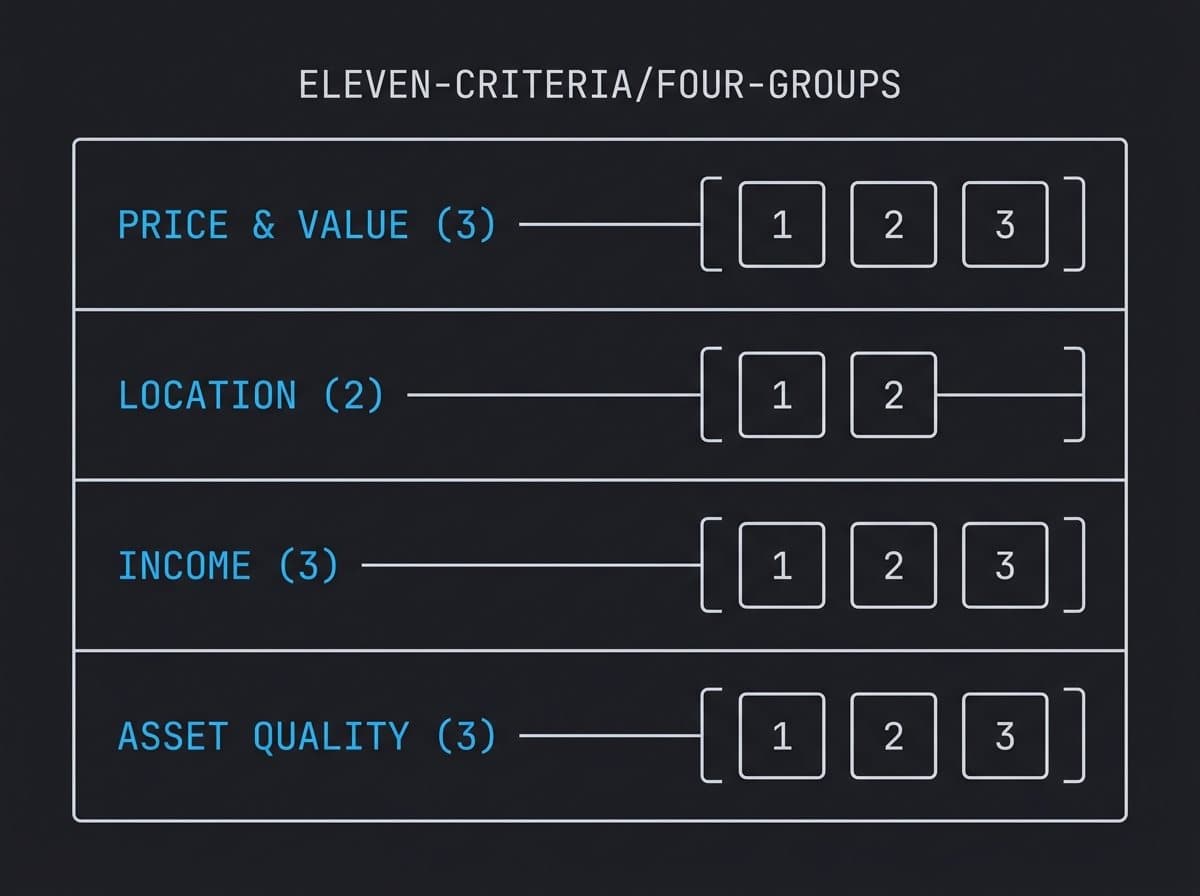
Pando's buy box runs eleven criteria. The exact thresholds are the operating edge, but the categories — which any investor can adapt — look like this:
Price and value (the margin)
- Acquisition ceiling — a hard maximum purchase price for the market tier.
- Minimum equity spread — the post-renovation comparable value must exceed all-in cost by a set margin, or the deal has no reason to exist.
- Renovation ceiling — rehab cost capped relative to value, so a project can't quietly become a rebuild.
Location (the floor under the asset)
- Flood-zone exclusion — FEMA zone A is an automatic pass, no override. The river is a neighbor, not a tenant.
- Market rules — towns and blocks with demonstrated rent demand; the small-town fundamentals four-factor test, encoded.
Income (the reason to own it)
- Cap-rate floor — minimum unlevered yield on all-in cost.
- Cash-on-cash floor — minimum levered return at conservative financing assumptions.
- Rent-evidence rule — the rent figure must be supported by comparable leases, not hope.
Asset quality (the next twenty years)
- Structure and envelope standards — foundation, frame, and roof must justify the renovation rather than absorb it.
- Condition-grade floor — below a threshold, walk; the tail of the housing stock is cheap for permanent reasons.
- Title and tax cleanliness — clear chain, no surprise liens, parcel records that reconcile.
Most properties fail somewhere in lines 2, 4, or 10. That's not bad luck — that's the filter doing the only job it has.
Pass/fail or it isn't a buy box
The common failure mode is owning a beautiful checklist and treating it as a scorecard: "nine out of eleven, and the two misses are small…" A scored buy box is a mood ring. The deals that hurt are almost never the obvious disasters — they're the near-misses that a pass/fail rule would have killed and a scoring rule rationalized.
If a criterion keeps killing deals you genuinely believe in, the answer is to amend the criterion in writing so it applies to every future deal equally. Rules can evolve. Exceptions metastasize.
How Pando handles this
Every property that reaches the Pando deal room cleared all eleven criteria — the evaluation runs the full list on every submission, and the result is published with the deal so an investor can see exactly what passed and why. The pass rate is low by design; the deals that survive carry the margin the box exists to protect, which is why equity at close is an output of the system rather than a marketing claim.
FAQ
What is a buy box in real estate? A written pass/fail list a property must fully clear before purchase — price, value margin, location, income, and condition rules.
What should be in a rental property buy box? Price ceiling, minimum discount to value, rehab ceiling, hard location exclusions, and income floors, at minimum.
Why pass on most properties? Because the box exists to kill the deal that almost works — the most expensive kind.
Should I ever make exceptions? Amend rules in writing for all future deals; never grant one-time exceptions under pressure.
Next step
Request access to see the eleven-criteria result published on live deals — including what passed and by how much.
See the discipline in practice.
Vetted investors get first look at every deal Pando announces — evaluation numbers, not marketing numbers.
The console has read this article. Ask for the short version, the main points, or anything it raised.


