
Assignment vs Double Close: How Wholesale Deals Actually Transfer
Two ways a wholesale deal reaches the end buyer: contract assignment or double close. What each means for you, what it costs, and what to verify.

A wholesale deal reaches its end buyer one of two ways: the operator assigns the purchase contract to you and steps aside, or the operator double closes — buying the property and reselling it to you in a back-to-back transaction. Both are legal and common; they differ in cost, paperwork, and how visible the operator's spread is.
The two structures, plainly
Every wholesale transaction has three parties: the seller (A), the wholesale operator (B), and the end buyer (C). The equity-at-close math is the same either way — the structures differ only in how title moves.
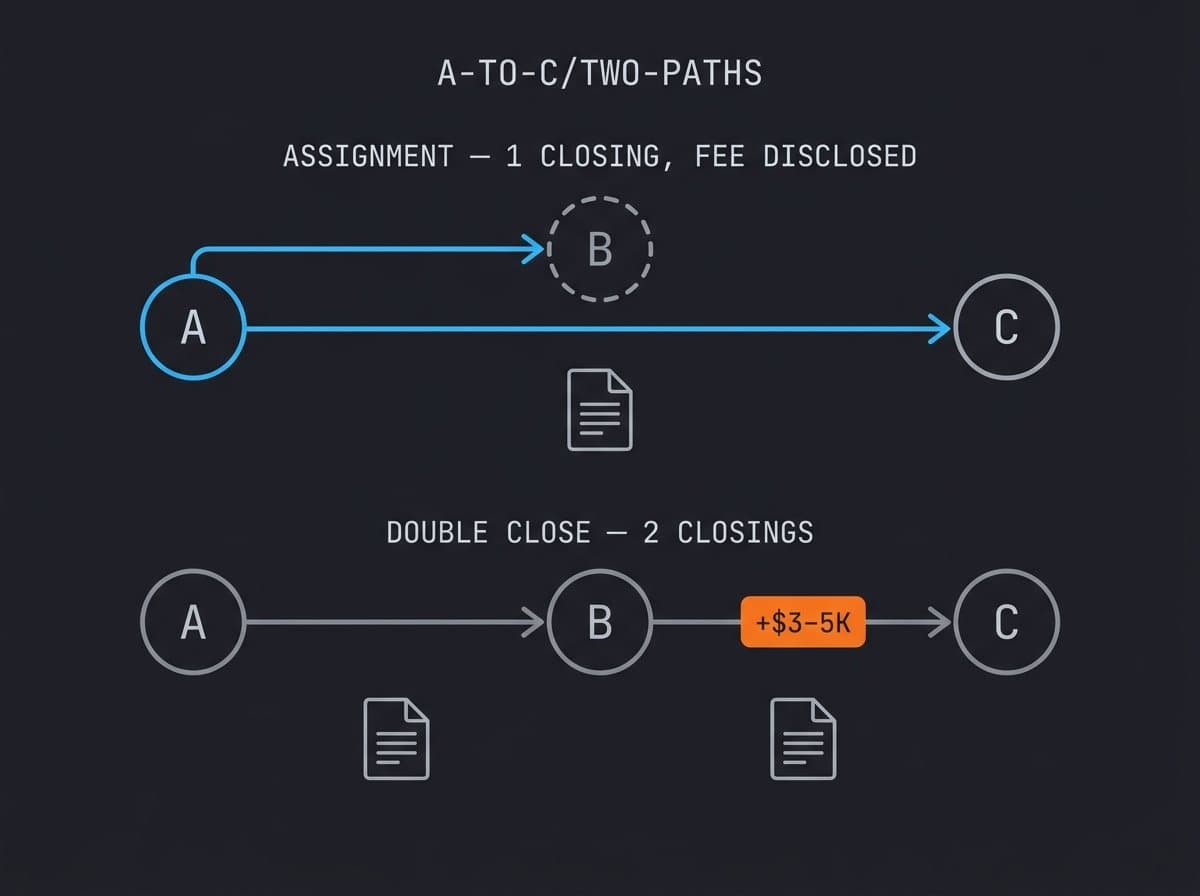
Assignment (A→C, with B stepping out). The operator signs a purchase agreement with the seller, creating an equitable interest in the property. That contract position is then assigned to you for a fee. You close directly with the original seller; the operator never takes title. One closing, one set of closing costs, and the assignment fee appears in the paperwork.
Double close (A→B, then B→C). The operator actually purchases the property — owning it briefly, sometimes only minutes — and immediately resells it to you in a second transaction. Two closings, two sets of costs, often short-term funding fees in between. The operator's spread lives inside the gap between the two prices and doesn't appear on your settlement statement.
Structural comparison — representative figures
Why the structure matters to you
Mostly, it doesn't change what you own — you end up on title either way. It changes three practical things.
Cost. A double close adds a second set of closing costs and any transactional funding fees. Those costs come from somewhere, and that somewhere is usually the spread you're paying.
Transparency. An assignment puts the operator's fee in writing in front of you. A double close hides it. An operator who double-closes specifically to avoid showing the spread is telling you how they think about disclosure — weigh it the same way you'd weigh any answer on the wholesaler verification checklist.
Eligibility. Some contracts can't be assigned. Bank-owned properties, HUD homes, and short sales usually prohibit it, which makes a double close the only legal path. Structure driven by the seller's paperwork is normal; structure driven by concealment is a flag.
What to verify under either structure
1. The original contract exists
Ask to see the A-B purchase agreement (price can be redacted in a double close, though an operator confident in their basis often shows it). No underlying contract means there's nothing to assign.
2. The assignment is in writing
For assignments: a signed assignment agreement naming you, the fee, and the original contract. Verbal assignments are not a thing you accept.
3. Title is searched and insured
Whichever path the deal takes, a full title search and an owner's policy protect you from what the structure can't — liens, gaps, heirs, judgments.
4. State disclosures were made
Iowa's wholesaler disclosure framework (HF 2374) requires specific disclosures when equitable interests are marketed. Confirm they happened. An operator who treats this as routine paperwork is the operator you want.
How Pando handles this
Pando transfers by assignment, with the spread disclosed. The legal model is the one Iowa's disclosure framework anticipates: we sign a purchase agreement with the seller, hold the equitable interest through renovation planning, and assign that interest to a vetted investor at a transfer price set below comp value. One closing, your own title work encouraged, our numbers on the table. We'd rather lose a deal to a question than win one on a blur.
FAQ
What's the difference between an assignment and a double closing? Assignment: you take over the operator's contract and close once with the original seller, fee disclosed. Double close: the operator buys and resells to you — two closings, spread not shown.
Which structure is better for the buyer? Usually assignment — fewer costs and full visibility. But a double close forced by a non-assignable contract is ordinary, not sinister.
Why do some wholesalers prefer double closing? Either the contract prohibits assignment, or they'd rather not show the spread. Ask which. The answer is informative.
What do I verify either way? The underlying contract, the written assignment, full title work with an owner's policy, and Iowa's required wholesaler disclosures.
Next step
Walk through how a Pando transfer works end to end — or request access and see the structure on a live deal, spread included.
See the discipline in practice.
Vetted investors get first look at every deal Pando announces — evaluation numbers, not marketing numbers.
The console has read this article. Ask for the short version, the main points, or anything it raised.


