
Buying From a Wholesaler: What Smart Investors Verify First
Wholesalers have a trust problem — some of it earned. The six things to verify before buying from one, and what a legitimate operation looks like.

Buying from a wholesaler is safe exactly to the degree you verify three things: that they actually control the property, that the value claim survives your own comps, and that the paperwork matches the pitch. Here's the full checklist a skeptical investor runs — and what it looks like when an operator passes it.
Why wholesalers have a trust problem
Some of it is earned. The barrier to calling yourself a wholesaler is a phone and a contract template, and the loudest corners of the industry are guru courses teaching exactly that. The result: investors encounter operators marketing properties they don't control, at values they invented, with paperwork they're improvising.
The model underneath is legitimate — and states have started regulating it directly (Iowa's disclosure law, HF 2374, is its own article). A wholesaler signs a purchase agreement with a seller, creating an equitable interest in the property, then assigns that interest to an end buyer for a spread. Done honestly, everyone's position improves: the seller gets a fast certain close, the buyer gets a below-comp basis, the operator earns the spread for finding and structuring the deal.
The job is telling the honest version from the improvised one. Six checks do it.
The six verifications
1. Control: do they actually hold the interest?
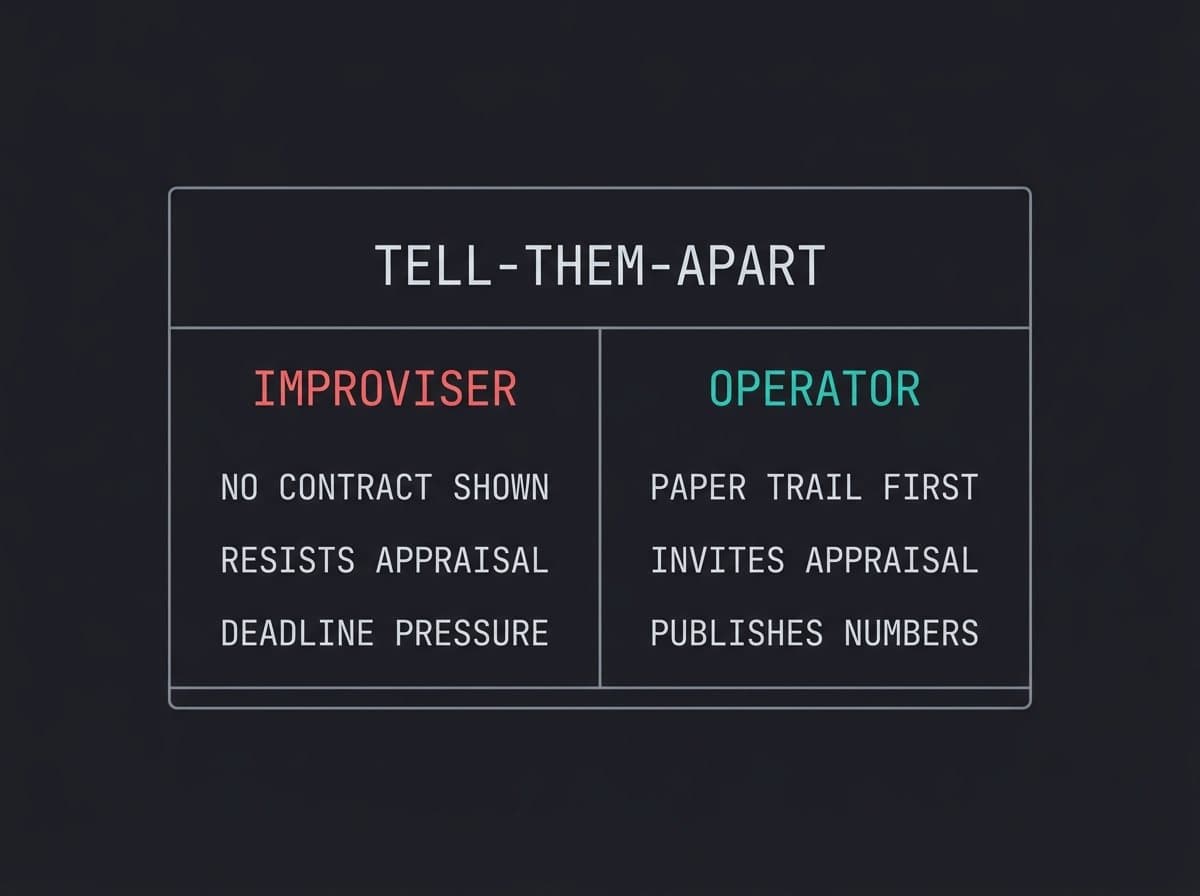
Ask to see the purchase agreement between the wholesaler and the seller. Not a summary — the agreement. It should name the property, the seller, the price, and be signed. An operator marketing a property without a signed contract is selling something they don't have.
2. Value: does the number survive your comps?
Every wholesale pitch includes a value claim. Treat it as a hypothesis: pull the comps yourself and order your own appraisal before closing. The single most reliable separator: a legitimate operator encourages the independent appraisal. An improviser talks you out of it.
3. Condition: renovated by whom, to what standard?
If the property is sold as renovated, the questions are: whose crews, what scope, and is there documentation (before/after photos tied to a scope of work, permits where required, warranty terms)? "Fully rehabbed" without a paper trail is a paint job until proven otherwise.
4. Disclosure: are they compliant in their state?
A growing list of states requires wholesalers to disclose their position — that they hold an equitable interest, not title. An operator who is fluent in their state's disclosure framework and volunteers it is showing you their operation. One who treats the question as hostile is showing you something else.
5. Paperwork: the assignment, the title, the timeline
Before money moves you should hold: the assignment contract, a title commitment from a real title company, and a closing timeline with a named closing agent. Wholesale deals close fast — that's a feature — but fast and undocumented are different things.
6. Track record: have they done this before?
Closed deals with verifiable outcomes beat any pitch. Ask how many properties they've transferred, in what markets, and whether you can see the numbers on past deals. A real operator keeps score in public.
How Pando handles this
Pando is a wholesale operator that built its entire surface around this checklist, because the skeptical buyer is the buyer we want. Every deal page publishes the evaluation numbers — acquisition logic, renovation scope by local crews, transfer price, comparable-sales basis — built to be independently verified. Disclosure runs under Iowa's HF 2374 framework on every transaction, and properties only reach the deal room after clearing all eleven buy-box criteria. Run the six checks on us; that's what they're for.
FAQ
Is buying from a real estate wholesaler safe? Safe to the degree you verify: control, value, and paperwork. Never to the degree you trust.
What are the red flags? Resistance to your appraisal, no purchase agreement shown, deadline pressure, comps from better streets, vagueness on disclosure.
Why do wholesalers sell below market value? Velocity — the spread on each deal is the business; leaving value for the buyer makes the next deal possible.
What paperwork should I see? Purchase agreement, assignment contract, state disclosures, title commitment. All four, before money moves.
Next step
Request access and run the six checks against live Pando deals — the documentation is already on the table.
See the discipline in practice.
Vetted investors get first look at every deal Pando announces — evaluation numbers, not marketing numbers.
The console has read this article. Ask for the short version, the main points, or anything it raised.


