
After the Close: Tenant Placement, Management, and Month One
The deal isn't done at the closing table. Tenant placement, management handoff, utilities, insurance, and the month-one checklist that protects the math.
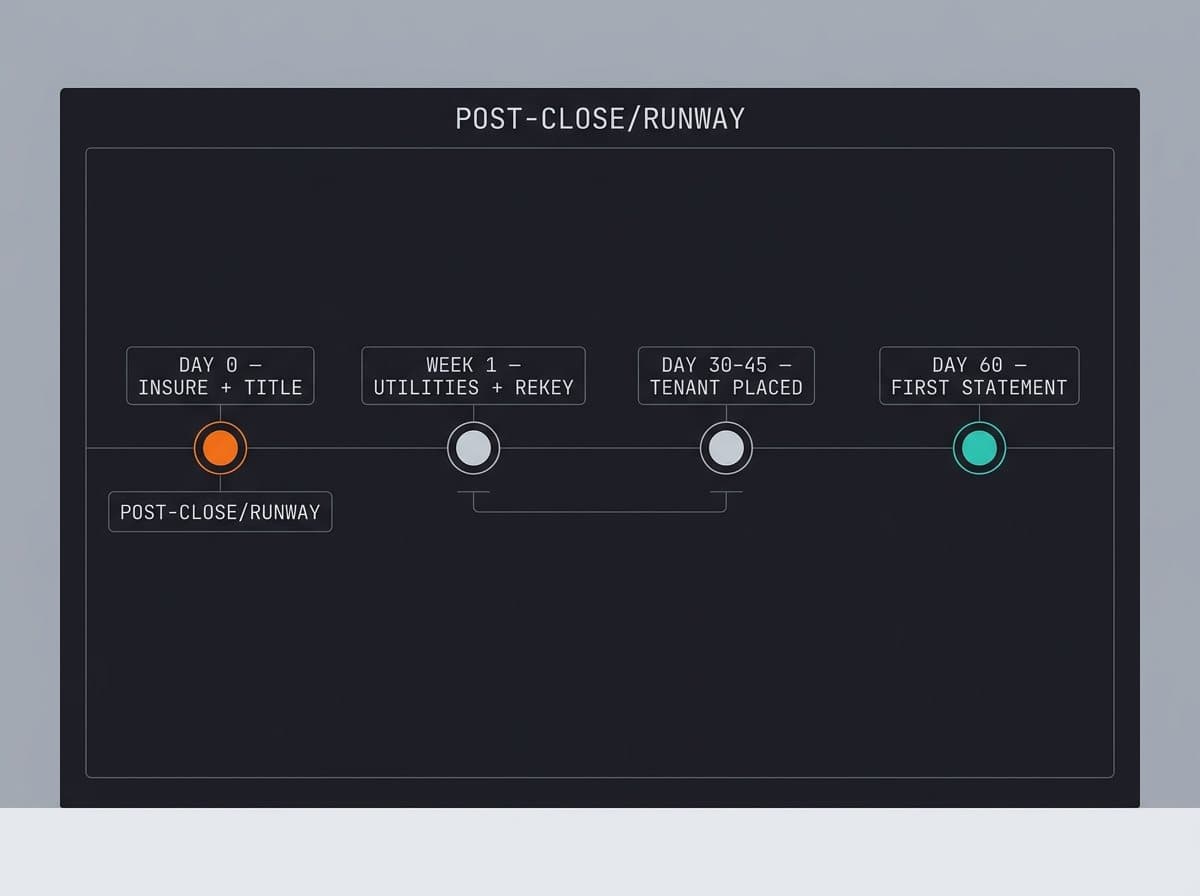
A rental purchase finishes about 60 days after the closing table: utilities, insurance, and locks in week one; management live and marketing up immediately; a screened tenant paying by day 45; the first clean owner statement a month later. The investors who struggle aren't unlucky — they treated the close as the finish line instead of the handoff.
The part of the deal nobody models
Evaluation gets all the attention — the comps, the equity, the diligence. But the most common way a good purchase becomes a mediocre investment is the runway after closing: a vacant month here, an uninsured week there, a tenant screened on vibes. The post-close phase has its own checklist, and it's shorter than the buying one.
The post-close runway — vacant-at-transfer case
Week one: boring, mandatory
Insurance from day zero. A landlord (dwelling-fire) policy active the day you take title — vacancy endorsed if the property is empty, because standard policies treat vacancy badly. The gap between closing and "I'll call this week" is where uninsured losses live.
Utilities in your name. Power and water stay on for showings, maintenance, and freeze protection. In winter markets, a dead furnace in a vacant house is a burst-pipe machine.
Rekey everything. You don't know who has keys. Forty dollars a door closes the question.
Paper the baseline. Date-stamped photos or video of every room and mechanical — the condition record that anchors deposits and insurance claims later.
Tenant placement: the system, not the hope
A vacant property costs its monthly rent in silence, so placement starts the day marketing photos exist.
1. Price at street-honest rent
The rent that fills the unit in 30 days beats the rent that fills it in 90. Verify against actual leases on comparable streets — the same verification discipline as everything else in the deal.
2. Screen against written criteria
Income multiple, references actually called, eviction and criminal checks within legal bounds — written down before the first applicant, applied identically to all of them. That's both fair-housing compliance and better tenancies.
3. Use the statutory lease
A lease built for your state's rules — in Iowa, that means deposit handling, notice periods, and entry terms per chapter 562A. A borrowed out-of-state form is a liability with signatures.
4. Document move-in like you'll need it
Walkthrough with photos, signed condition report. Deposits are won and lost at move-in, not move-out.
The management decision
For out-of-state owners, a local manager at 8–10% of collected rent is usually the highest-ROI line in the budget: screening, dispatch, compliance, and a local number tenants can call at 2 AM. Interview before closing; ask for their owner statement format, maintenance markup policy, and average days-to-lease. If you self-manage anyway, build the vendor bench first — plumber, electrician, HVAC, handyman — because the furnace will not wait for you to find one.
How Pando handles this
Operational continuity is a standing objection to buying remotely, so Pando builds the runway into the transfer: properties hand off rent-ready with the renovation documented, baseline photo records included, and local management options — managers who already work these streets — introduced before closing, not after. Where a tenant is already placed, the lease, deposit records, and payment history transfer with the deal. The model is judged on month thirteen, not the closing table, and the first 60 days are where month thirteen is built.
FAQ
What do I do right after closing? Insurance from day zero, utilities transferred, locks rekeyed, condition documented. Then marketing, immediately.
How long until a tenant? 30–45 days for a renovated unit at honest rent in a real rental market. Longer means a number is wrong.
Should I self-manage from out of state? Usually no — 8–10% buys a local system you can't replicate remotely. Interview managers before you close.
What makes placement go wrong? Aspirational rent, unwritten screening criteria, and borrowed lease forms. All three are avoidable before the first showing.
Next step
See how Pando transfers a rent-ready property — or request access and look at the handoff package on a live deal.
See the discipline in practice.
Vetted investors get first look at every deal Pando announces — evaluation numbers, not marketing numbers.
The console has read this article. Ask for the short version, the main points, or anything it raised.


