
Iowa Property Taxes on Rentals: What Investors Actually Pay
How Iowa property tax actually works on a rental — assessment, rollback, levy — with the math on a representative river-town single-family.

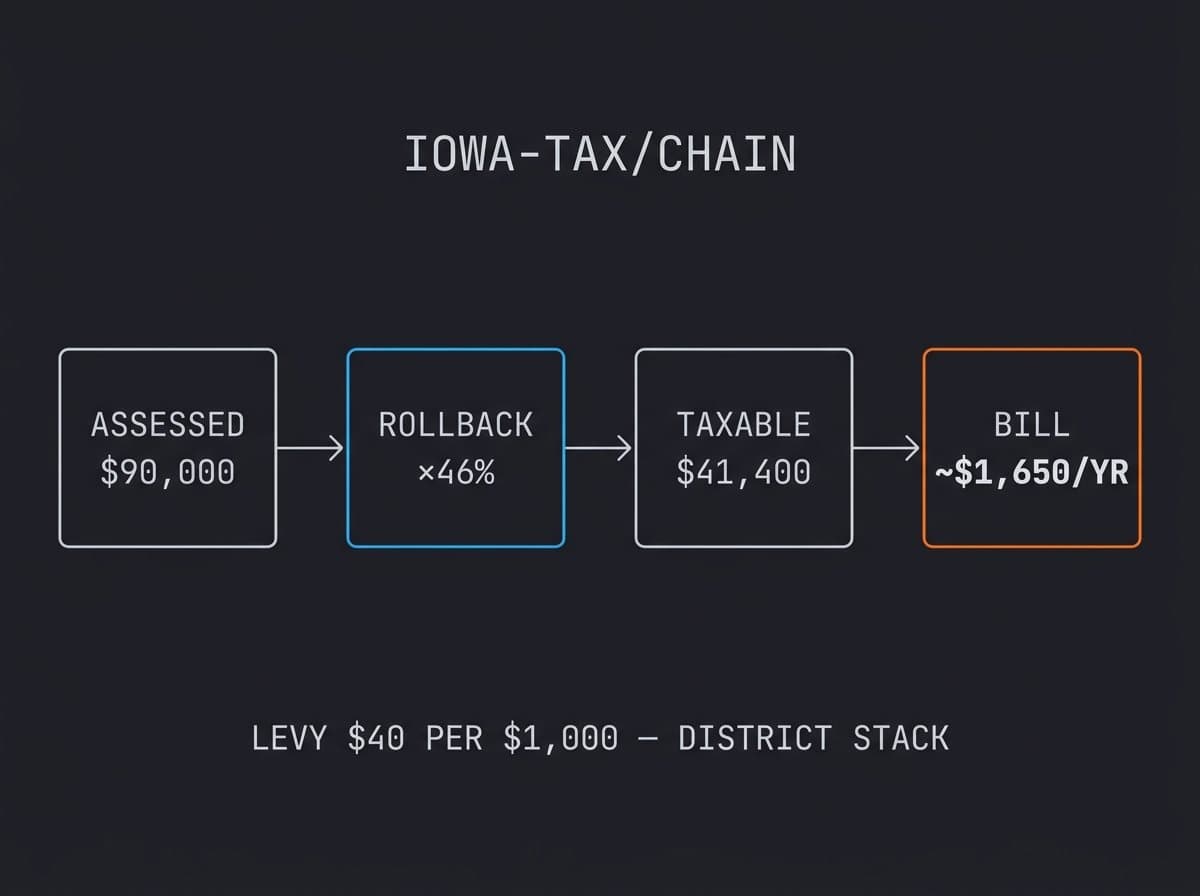
An Iowa rental's tax bill is three numbers multiplied: assessed value × the state's residential rollback × the local levy rate. On a representative $90,000 river-town single-family, that chain lands a bill near $1,500–$1,900 a year — knowable to the dollar before you buy, because every number in the chain is public.
The chain, link by link
Assessed value. The county assessor values the property at market; records are public on each county's Beacon-style portal, including the assessment history and comparable treatment of neighbors. (This is the same public substrate the whole cost picture is built from.)
The rollback. Iowa's distinctive move: a statewide percentage, reset annually, that limits how much of assessed value is taxable. For residential property — which includes 1–4 unit rentals — the rollback has recently run in the mid-40s percent. [FACT-CHECK: confirm the current assessment-year residential rollback percentage before publishing externally-cited figures.] A $90,000 assessment thus taxes on roughly $42,000–$45,000.
The levy. Each taxing district — county, city, school, misc — stacks its rate per $1,000 of taxable value. Small-town Iowa levies commonly stack into the $30s–$40 per $1,000.
Representative river-town single-family — verify per parcel
Why this matters to the river-town math
Out-of-state investors price Iowa taxes wrong in both directions. Coastal buyers see "high levy rates" in national tables and overstate the bill — the tables ignore the rollback. Sunbelt buyers assume taxes are negligible and skip the line entirely — and a $1,700 bill on a $76,000 basis is over 2% of basis a year, a real expense line that belongs in every cap-rate computation.
Priced correctly, taxes are one of the river-town model's quieter advantages: the dollar bill on a $90,000 house is a fraction of the bill on the same house priced at $400,000 elsewhere, while rents differ far less than prices do.
Running the number before you buy
1. Pull the parcel's actual bill
Skip the estimates — the county treasurer shows the current bill and its history for any parcel. Five minutes, exact dollars, no model required.
2. Check for assessment shock
A recent sale or renovation can trigger reassessment. If the property last assessed below its renovated reality, budget the post-renovation assessment, not the trailing bill. Ask what comparable renovated properties on the street assess for — public records answer this too.
3. Drop the credits you won't get
Owner-occupant credits (homestead, military) come off the seller's bill but not yours. If the listing quotes the credited number, add the credits back.
4. Calendar the installments
September and March, in arrears. Escrow them mentally at 1/12 a month — Iowa's landlord rules govern the tenant side of your ledger; the treasurer governs this side on a fixed schedule.
How Pando handles this
The tax line on a Pando deal page is the parcel's actual treasurer figure, pulled from county records during evaluation — not an estimate, and never the seller's credited bill. Where renovation will plausibly move the assessment, the deal page says so and models the post-renovation figure. It's one line of the eleven-criteria evaluation, and one more number you can verify against the county yourself before wiring anything.
FAQ
How is an Iowa rental's tax computed? Assessed value × residential rollback × district levy. All three numbers are public per parcel.
What's the rollback? Iowa's statewide cap on taxable value, reset annually — recently mid-40s percent for residential, which includes 1–4 unit rentals.
Do investors pay more than owner-occupants? Same classification; you just lose owner-occupant credits, so modestly more.
When is it due? September and March, in arrears. Budget monthly.
Next step
See how taxes flow into Pando's deal math — or request access and check a live deal's tax line against the county treasurer yourself.
See the discipline in practice.
Vetted investors get first look at every deal Pando announces — evaluation numbers, not marketing numbers.
The console has read this article. Ask for the short version, the main points, or anything it raised.


